Stoker 1st Class SS/104596 Arthur Bull
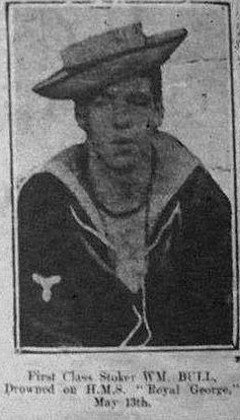
Regiment/Unit: Royal Navy - (RFR/DEV/B/4181). H.M.S. Goliath
Theatre of War: At Sea
Age at death: 27
Date of death: 13th of May 1915
Born: Manchester
Resided: St Helens, Lancs
Burial / Memorial: Plymouth Naval Memorial - 6.
BMD details:
Birth Date: 11 Apr 1888. Marriage: 04/04/1914 Arthur Bull to Annie Brady at Eccleston St Thomas. Vol 8b - Page 1167.
Family details:
Wife Annie. 104, Raglan Street, St Helens. Lancs.
Census details:
1891 - 3 years old schoolboy Arthur is living at 150 (shop) Gorton Lane, Gorton with parents Amos (36), Catherine (32) and two siblings: Annie (12), John (10). 1901 - 11? years old Arthur is living at Golborne Road, Newton-In-Makerfield with remarried(?) father Amos (44), stepmother(?) Elizabeth (41) and sister Samilia (9). Boarding at the address are Edward McDonald (47) and James Allen (45). 1911 - Sees 22 years old 'Stoker' Arthur based on H.M.S King Alfred, Newton Abbot, Torquay.
Notes:
Age taken from SDGW.
Age taken from SDGW.
Killed in action with Turkish destroyer in Dardanelles 13-May-1915.
[pic]imgs/S1PWHYAOTV/HMS_Goliath.jpg[/pic][caption] H.M.S. Goliath[/caption]
HMS Goliath.
Goliath was a pre-dreadnought Battleship of the Canopus-class.
Class of 6 ships, Goliath built by Chatham Dockyard, launched 23 March 1898, completed March 1900, 12,950 tons, 421ft long, armed with 4-12in/12-6in/12-12pdr guns, 18 knots, 680 crew.
Joined the Channel Fleet in 1906, but reduced to nucleus crew in March 1907 after being fitted with fire control. Machinery overhauled August 1907-February 1908 and then went to Malta (en route one of her propeller shafts fractured, necessitating a 4-month repair). Joined 4th Fleet at Nore in April 1909, and then 3rd Fleet in 1913-14.
WW1 Service.
HMS Goliath served off the east coast of Africa and on the Dardanelles in the early years of the First World War. Like the rest of her class, at the start of August 1914 she joined the 8th Battle Squadron of the channel fleet, helping to cover the passage of the BEF to France. She remained with the channel fleet for longer than her sister ships. In late August she was used to ship the Plymouth battalion of Marines to Ostend.
In September she was dispatched to the East Indies station, to help escort the Indian army to the Middle East and east Africa. On 30 October she arrived at Mombasa with the Indian Army expedition to German East Africa, but she then needed repairs before she could continue, forcing the expedition to proceed without the support of her guns. By 28 November she had been repaired and was able to take part in the bombardment of Dar-es-Salaam, but she then needed to go to the Cape for a further refit.
She was repaired by 25 February 1915, when Admiral King-Hall sailed in her from the Cape to German East Africa. She reached Mafia Island, off the Rufiji Delta, on 7 March. Admiral King-Hall wanted to keep her at Mafia Island, to guard against the danger of a breakout by the Konigsberg, a series danger during a period of high tides, but on 25 March he was ordered to shift his flag, and she was ordered to go to the Dardanelles.
Her journey took her through the Suez Canal, where she was initially expected to stay for a time, but on 12 April she was ordered to proceed directly to the Aegean, where she was needed to support the Gallipoli landings. On 25 April she formed part of the First Squadron, used to support the landings at the tip of the peninsula. On the next day she was used to help the evacuation of Y Beach, the only one of the initial landings to fail. On 29-30 April she was briefly detached to defend the Suez Canal against an expected Turkish attack, but was recalled when French ships were sent to Suez.
On the night of 12-13 May, HMS Goliath and HMS Cornwallis were chosen to support French troops on the right of the Allied line. The Goliath anchored off Morto Bay. On the same night, Lieutenant-Commander Firle, a German officer serving with the Turkish fleet, got permission to take the destroyer Muavenet-I-Miliet (600 tons, top speed 33 knots, armed with three torpedo tubes, built in 1909) through the straits to attack the Allied battleships. Aided by the fog, he got within torpedo range of the Goliath before he was spotted and challenged. He fired three torpedoes, and then escaped to safety.
The first torpedo hit the Goliath by her forward 12in turret. She then began to list to port. The second torpedo hit by the forward funnel. The ship continued to turn over, and was nearly on her beam ends when the third torpedo hit near her aft 12in turret. She then turned turtle, floated upside down for a couple of minutes and then sank bows first. Of the 750 men then serving on her, 570, including Captain Shelford, were lost.
[pic]imgs/WW1_memorials/Arthur_Bull.jpg[/pic][caption]The panel on the Plymouth Naval Memorial bearing
the name of Stoker 1st Class Arthur Bull[/caption]
